What a Roof Replacement Actually Costs in Columbus — And Why Prices Are Where They Are
A transparent breakdown of materials, labor, tariffs, and market forces shaping every roofing quote across Dublin, Powell, Worthington, and the northern Columbus corridor this spring.
If you've started getting quotes for a roof replacement this spring, you've probably noticed something: the numbers are higher than you expected. You're not imagining it, and it's not just one contractor padding a bid. Roofing costs have genuinely shifted — across the board, across every material — and homeowners in Dublin, Powell, Worthington, Upper Arlington, Hilliard, and Plain City are all feeling it at the same time.
The good news is that there's nothing mysterious about why. The forces driving roof replacement pricing in 2026 are specific, well-documented, and worth understanding before you commit to a project or sign a contract. This guide breaks down what a new roof actually costs in the northern Columbus corridor right now, what's behind those numbers, and how to make a smart investment even in a higher-cost market.
What Columbus Homeowners Are Actually Paying Right Now
Let's get straight to the numbers. In the Columbus metro — and particularly across the northern suburbs — here's what a residential roof replacement looks like in spring 2026:
Asphalt shingle roofs remain the most common choice in central Ohio, and for good reason. A standard asphalt replacement on a typical 1,500 to 2,500 square foot home currently runs between $9,000 and $15,000 in the Columbus market. That's the installed price — materials, labor, tear-off of the existing roof, and disposal included.
Within that range, the material tier you choose makes the biggest difference. Three-tab shingles — the most basic option — fall around $3.50 to $5.00 per square foot installed. Architectural shingles, where most homeowners in our service area land, run $4.00 to $8.50 per square foot. They're thicker, more wind-resistant, and carry longer warranties — typically 25 to 30 years versus 15 to 20 for three-tab.
Metal roofing is the premium tier, and it's where the pricing conversation gets more interesting. Standing seam metal systems currently range from $10.00 to $16.00 per square foot installed — roughly double to triple the cost of architectural shingles.
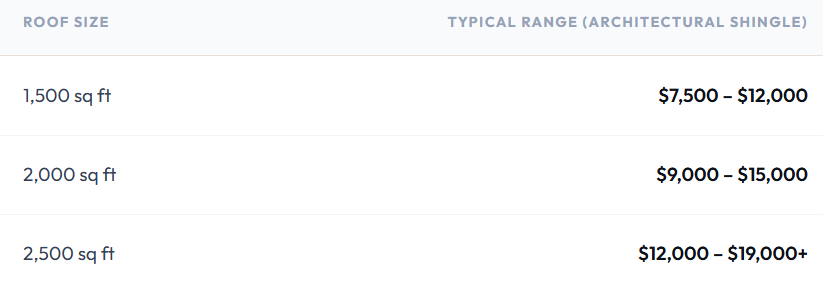
Ranges reflect typical homes in Dublin, Powell, Upper Arlington, and Worthington. Complexity factors — steep pitch, multiple dormers, skylights — push toward the upper end.
These ranges are meaningfully higher than what the same projects would have cost two or three years ago. Here's why.

The Three Forces Driving Roofing Costs Higher in 2026
Five years ago, the price of your roof came down to two variables: size and material. Those still matter, but in 2026, three additional forces are shaping every quote you receive — and none of them are going away soon.
Tariffs Have Changed the Math on Every Metal Component
This is the single biggest factor homeowners don't know about — and it affects every roof, not just metal roofs.
In mid-2025, Section 232 tariffs on imported steel and aluminum doubled from 25% to 50%. As of April 2026, those tariffs remain fully in effect with no rollback on the horizon. The Commerce Department also expanded coverage to over 400 categories of derivative products — meaning anything substantially made from steel or aluminum now carries the tariff.
For metal roofing, the impact is direct and significant. But here's what most homeowners miss: tariffs affect asphalt shingle roofs too. The metal flashing around your chimney, vents, and skylights. The drip edge along your eaves and rakes. The fasteners holding everything together. The aluminum components in your ridge vent. Every one of those items contains tariffed metal, and those costs get passed through to your installed price.
On top of the metal tariffs, copper now carries its own 50% tariff. And chemical components used in roofing adhesives, fire retardants, and insulation have seen tariff rates as high as 60% on certain products.
Manufacturer Price Increases Set a New Baseline
Independent of tariffs, the three dominant shingle manufacturers — Owens Corning, GAF, and CertainTeed — all implemented price increases of 6% to 10% in early 2025. Those weren't temporary surcharges. They established a new cost floor that every contractor in central Ohio is now building from.
The underlying reason is that asphalt shingles are petroleum-based products. The Bureau of Labor Statistics Producer Price Index for asphalt paving and roofing materials has remained near record highs since 2022. The National Association of Home Builders has noted that residential construction input prices have maintained year-over-year growth above 3% since mid-2025.
What this means practically: even the most basic three-tab shingle costs more today than a mid-grade architectural shingle did a few years ago. Contractors aren't marking up beyond what the market requires — they're reflecting real input cost changes.
Labor Is Scarcer and More Expensive Than It's Ever Been
This is the force that hits closest to home — literally. The construction industry nationally needs to attract roughly 349,000 new workers in 2026 just to keep pace with demand, according to Associated Builders and Contractors. That figure jumps to 456,000 in 2027. Nearly one in five construction workers is over 55, and retirements are outpacing new entrants across every skilled trade.
Roofing is one of the hardest-hit specialties. The NAHB reports that immigrants make up approximately 34% of all construction workers nationally, with that share exceeding 60% in trades like roofing and drywall. Current immigration enforcement policies have created real disruption — a recent industry survey found that 28% of construction firms experienced workforce disruptions within the past six months.
In central Ohio specifically, data center construction, federally funded infrastructure projects, and a strong residential market are all drawing from the same pool of skilled tradespeople. When a qualified roofing crew can choose between projects, labor rates rise — and those rates currently make up roughly 60% of your total roof replacement cost.
For homeowners in Hilliard, Plain City, and the western suburbs, this labor dynamic is especially relevant. These communities are seeing significant residential growth, which means local crews are stretched thinner than in more established neighborhoods.

Why Waiting Probably Won't Save You Money
When homeowners in Powell or Upper Arlington see a quote that's higher than expected, the natural instinct is to wait. Maybe tariffs will come down. Maybe material prices will ease. Maybe next year will be cheaper.
The data doesn't support that strategy.
Market Reality Check
The 50% steel and aluminum tariffs show no signs of reduction. Industry forecasts project domestic steel prices holding steady or rising slightly through the remainder of 2026. The labor shortage is structural — driven by retirements and demographics — not a temporary slowdown that will correct itself.
Meanwhile, waiting introduces its own costs. A roof that needs replacement today will only deteriorate further over the next 12 months — water intrusion, compromised decking, insulation degradation — all of which add to the scope and expense when you eventually move forward.
There's also a scheduling reality. Roofing contractors across the Columbus metro book up quickly from May through September. Homeowners who move forward now typically get faster scheduling, more flexibility on timing, and the ability to properly compare multiple bids. By midsummer, you're fitting into whatever window is available.
“Roofing costs in 2026 are higher than they were in 2024, and 2027 is unlikely to be cheaper. The best strategy isn’t to time the market — it’s to make a smart investment now with a clear understanding of what you’re paying for.”
How to Get the Most Value From Your Budget
Given today's pricing environment, the goal isn't to find the cheapest quote — it's to make sure every dollar goes toward long-term performance and protection. Here's how homeowners across the northern Columbus corridor can approach this wisely.
Demand a line-item estimate
A quality bid should itemize tear-off, underlayment type, ice and water shield, drip edge, starter strip, ridge cap, pipe boots, flashing, ventilation, and cleanup. In a market where every component costs more, knowing exactly what's included is how you compare contractors on equal footing.
Don't downgrade materials just because costs are up
Architectural shingles cost more upfront than three-tab, but they last 10 to 15 years longer and carry better warranties. Over a 30-year ownership period, paying more today for architectural shingles costs less in total than going three-tab and replacing again in 15 years at inevitably higher prices.
Evaluate metal roofing against your ownership timeline
Metal has taken the biggest tariff-driven price hit, but for homeowners who plan to stay 15+ years, it eliminates the cost of a second replacement entirely. A metal roof lasting 40 to 50 years often has a lower lifetime cost than two rounds of asphalt shingles.
Add insulation and ventilation while the roof is open
If your attic insulation hasn't been updated in 20+ years, a roof replacement is the most cost-effective time to address it. Budget an additional $1,000 to $3,000 — it's one of the highest-ROI add-ons you can make, reducing heating and cooling bills year-round.
Treat unusually low bids as a red flag
In today's labor market, a quote that comes in 30% below the rest means corners are being cut — materials, installation steps, or crew qualifications. A properly installed roof should last 25 to 50 years. A poorly installed one can fail in five. When materials cost more, installation quality matters more than ever.
What This Means for Home Value in Columbus
For homeowners thinking about resale — whether that's this year or five years out — a roof replacement remains one of the strongest home improvement investments available.
Industry data consistently shows that a new asphalt shingle roof recoups a significant portion of its cost at resale. In competitive suburban markets like Dublin, Worthington, and Upper Arlington, where buyers are comparing homes in similar price ranges, the condition of the roof is often a deciding factor. A new roof removes a major negotiation point and signals that the property has been well maintained.
Beyond resale, there's a practical financial benefit that plays out every month: energy efficiency. Homes in the northern Columbus corridor deal with both winter heating demands and summer cooling costs that have been rising steadily. A properly installed roof with modern materials and adequate insulation can meaningfully reduce that monthly expense — a return on investment that starts immediately and compounds over time.
The Bottom Line
Roofing costs are higher this year. That's a fact, and it's driven by real economic forces — 50% tariffs on steel and aluminum, manufacturer price increases on shingles, and a construction labor market that's tighter than it's been in decades. None of these factors are temporary, and none suggest that waiting will produce a better price.
What hasn't changed is that your roof is the single most important protective system on your home. The homes across Dublin, Powell, Worthington, Upper Arlington, Hilliard, and Plain City are significant investments — many in the $400,000 to $800,000+ range. Protecting that investment with a properly installed, high-quality roof is not discretionary spending. It's the foundation everything else depends on.
At AC Roofing and Siding, we believe homeowners make better decisions when they understand what they're paying for. We provide detailed, line-item estimates. We explain what every component does and why it matters. And we never pressure anyone into a decision — because a roof replacement is a major investment, and you deserve to make it on your terms with full information.
Get a Transparent Quote for Your Home
We'll give you an honest, itemized estimate that reflects current material costs and market conditions — no surprises, no hidden charges.
Serving Dublin · Powell · Worthington · Upper Arlington · Hilliard · Plain City & surrounding communities
